Why AI Films Lack Emotion: Storytelling Matters More Than Realism
Why do AI films lack emotion? Discover why storytelling, not realism, is the future of AI filmmaking and how great directors create emotional impact.
Stewart Mugwiji
7/20/20265 min read
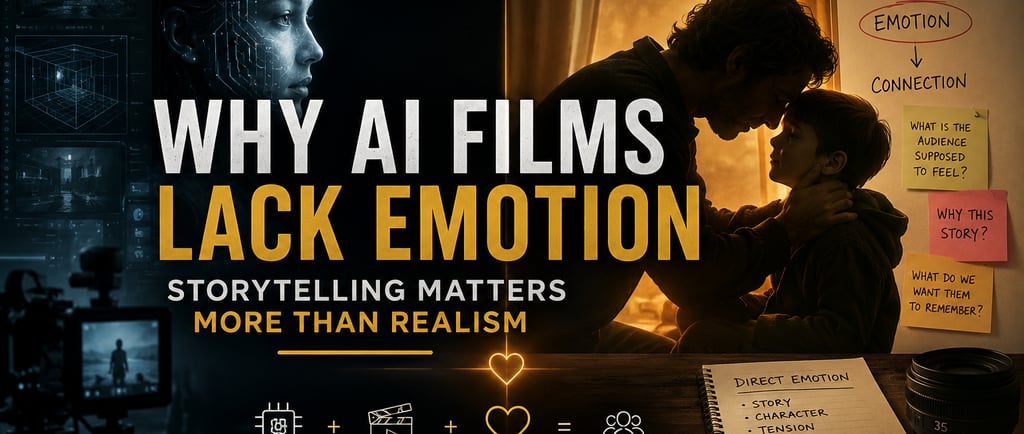
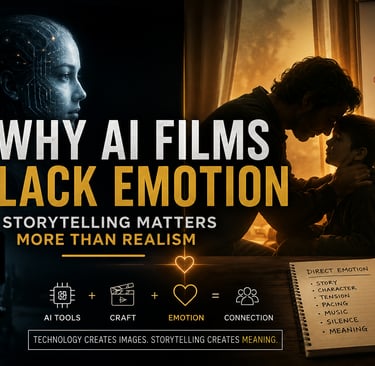
AI filmmaking is advancing at an astonishing pace. Visual quality is improving almost weekly, yet one criticism continues to surface: "It looks amazing, but I don't feel anything." The problem isn't that AI can't create beautiful images. The problem is that beautiful images alone have never made great films. Storytelling, emotion, and human connection are what audiences remember - and they remain the greatest competitive advantage in AI filmmaking.
Why Do AI Films Feel Emotionless?
One of the most common questions people ask about AI filmmaking is: - "Why do AI-generated films feel emotionless?"
Many assume the answer is technical - that AI simply isn't realistic enough. I believe the answer is much deeper. Most AI-generated films don't fail because of their visuals. They fail because they prioritise visual perfection over emotional storytelling.
Audiences don't connect with films because the lighting is flawless or because every frame looks cinematic. They connect because they care about the people on screen. They become invested in the conflict. They laugh, worry, hope and cry alongside the characters.
As AI filmmaking tools continue to improve, storytelling - not technology - will become the defining difference between memorable films and forgettable ones.
We Don't Fall in Love with Pixels
People don't watch films because they look real - They watch films because they feel real. If realism alone created emotion, then the most photorealistic film would automatically be the greatest film ever made. History tells us otherwise. Think about Toy Story. They are toys. Yet audiences laughed with them, worried for them and cried with them. Think about Up. Within the opening minutes, an animated film with stylised characters leaves millions of people in tears. Think about WALL·E. A small robot with barely any dialogue creates one of the most heartfelt love stories in modern cinema. None of these films relied on photorealistic human faces. They relied on something far more powerful - story, character, timing, emotion.
Why Most AI Filmmakers Focus Too Much on Realism
Many AI filmmakers - including myself at times - have fallen into the same trap. We obsess over realism - sharper skin textures, more cinematic lighting, better lens simulations, perfect camera movement, and higher consistency. These are all worthwhile pursuits. But somewhere along the way, we stopped asking the most important question in filmmaking: What is the audience supposed to feel right now? That single question changes everything. Because filmmaking has never been about generating beautiful images. It's about creating emotional experiences.
Great AI Filmmaking Requires Directing Emotion
Great directors don't simply compose beautiful shots. They direct emotion. Every creative decision exists for a reason. Why is the camera moving closer? Why is the room suddenly silent? Why is the lighting warm instead of cold? Why does the character pause before answering? Why is this scene slower than the previous one? These aren't technical decisions. They're emotional ones. The audience may never consciously notice them. But they will certainly feel them.
Current AI Filmmaking Limitations
Today's AI filmmaking tools are extraordinary. They can generate breathtaking visuals that would have required an entire production team only a few years ago. But they are also honest about their limitations. Human beings are remarkably sensitive to subtle performance. A slight hesitation. A trembling lip. Eyes that linger for just a fraction too long. A breath before speaking. Tiny facial movements that reveal uncertainty. These details have been refined by actors over decades of craft.
Current AI models are improving rapidly, but they aren't yet consistently capable of reproducing every nuance of authentic human performance. Audiences instinctively recognise when something feels slightly off. That's a genuine challenge. But it's only part of the story.
Emotion Doesn't Live Only in Faces
Cinema has always been much bigger than performance. Emotion can come from editing, from music, from silence, from pacing, from composition, from colour, from symbolism, and from the rhythm between scenes. Sometimes a single cut to silence is more emotional than the most expressive close-up. Sometimes what we don't show is more powerful than what we do. AI already gives filmmakers extraordinary creative control over many of these storytelling tools. The opportunity isn't simply to create prettier images. It's to create deeper emotional experiences.
The Future of AI Filmmaking Belongs to Storytellers
Eventually, AI-generated performances will become remarkably convincing. When that day arrives, beautiful visuals will no longer be a competitive advantage. Everyone will have access to them. The filmmakers who stand out won't necessarily be the ones using the newest AI models or writing the cleverest prompts. They will be the ones who understand human nature. The ones who study acting, psychology, screenwriting, music, editing, pacing, and empathy. Because technology can generate images - Only storytellers generate meaning.
Experience Still Matters
After nearly two decades working in filmmaking, one thing has become increasingly clear to me: technology changes far faster than storytelling. Every major innovation - from digital cameras to CGI, virtual production and now generative AI - has been presented as the future of filmmaking. Eventually, each became what it always was: another creative tool. The craft never disappeared. It simply evolved. AI will follow the same path. The filmmakers who thrive won't be those chasing every new tool. They will be the ones mastering the timeless principles that make audiences care.
A New Kind of AI Filmmaker
Perhaps we have been defining AI filmmaking too narrowly. An AI filmmaker isn't simply someone who knows how to write prompts. An AI filmmaker is a director of emotion who happens to use AI as one of many creative tools. The software will continue to evolve. The models will continue to improve. The workflows will become faster. But one thing won't change - People will always remember how a story made them feel. Beautiful visuals may capture attention. Meaningful stories capture hearts.
Frequently Asked Questions
Why do AI-generated films feel emotionless?
Many AI-generated films feel emotionless because creators often prioritise photorealistic visuals over storytelling, character development, pacing, editing and emotional direction. Audiences connect with stories - not just images.
Can AI create emotional films?
Yes. AI can absolutely help create emotionally engaging films. However, the emotional impact still depends on the filmmaker's ability to craft compelling characters, meaningful stories, thoughtful editing and strong direction.
Is AI replacing filmmakers?
No. AI is changing how films are made, but it isn't replacing creativity, storytelling or artistic judgment. The most successful AI filmmakers combine traditional filmmaking skills with modern AI tools.
Will AI replace directors?
AI can automate parts of production, but directing remains deeply human. Great directors make emotional decisions about performance, pacing, tone and storytelling - areas where human taste and empathy remain essential.
This belief sits at the heart of everything we create at Bengal Stripe films. As an AI Creative Director, my goal isn't simply to produce visually impressive AI commercials - it’s to craft stories that make audiences feel something and inspire them to act. Whether we are creating a luxury product film, a brand commercial, or a cinematic campaign, every creative decision begins with one question: What should the audience feel? That's the standard we bring to every project, and it's the difference between content that gets noticed and stories that get remembered.
Final Thoughts
AI filmmaking will continue to evolve at an extraordinary pace. The tools will become faster. The visuals will become indistinguishable from reality. The workflows will become simpler. But the principles of great cinema will remain exactly the same. Whether you are shooting on a cinema camera or generating scenes with AI, audiences will always remember stories that made them feel something. The future of AI filmmaking doesn't belong to those with the most advanced software. It belongs to the storytellers who understand people. Because AI is the tool. Storytelling is still the art.